
Direct Answer: Cost accounting and financial accounting both record and analyse business information, but they serve different purposes. Financial accounting focuses on recording transactions and reporting the overall financial performance and position of an entity, primarily for external and statutory users. Cost accounting focuses on identifying, measuring, analysing and controlling the cost of products, services, jobs or processes to support internal planning, pricing, efficiency and decision-making.
In simple terms
Financial accounting tells you how the business performed and what it owns and owes; cost accounting tells you what particular products, services, jobs or processes cost and helps management understand why those costs changed.
Cost Accounting vs Financial Accounting: Key Differences
The following table summarises the main distinctions between the two accounting disciplines.
| Basis | Cost Accounting | Financial Accounting |
| Primary objective | Determine, analyse, allocate and control costs | Record transactions and report financial performance and position |
| Main users | Management, cost controllers and internal decision-makers | Investors, lenders, regulators, tax authorities, management and other stakeholders |
| Scope | Products, jobs, processes, departments, services and cost centres | Business/entity as a whole |
| Level of detail | Highly detailed and cost-object specific | Generally aggregated financial information |
| Time focus | Historical as well as predetermined/standard or estimated costs | Primarily historical transactions |
| Reporting frequency | As required—daily, weekly, monthly or otherwise | Periodic reporting based on applicable requirements |
| Format | Flexible and designed around management requirements | More structured/prescribed depending on applicable reporting framework |
| Regulatory context | Generally internal, but cost records and cost audit can be mandatory for specified companies/sectors | Statutory and financial reporting requirements apply depending on entity and framework |
| Measurement | Can use monetary and operational quantities | Primarily monetary transactions |
| Profit focus | Product, job, process or service profitability | Overall entity profit or loss |
| Inventory valuation | Detailed costing/valuation analysis | Financial-statement inventory requirements |
| Abnormal items | Can identify and analyse abnormal cost | Recognised according to applicable financial reporting treatment |
| Decision use | Pricing, cost control, budgeting, efficiency and operational decisions | External reporting, accountability and assessment of financial position/performance |
Statutory applicability is a separate question. Whether a company must maintain prescribed cost records or undergo cost audit depends on the applicable provisions of Section 148 of the Companies Act, 2013 and the current Companies (Cost Records and Audit) Rules, including the company’s activities and other prescribed criteria.
Authoritative verification: MCA Companies (Cost Records and Audit) Rules, 2014, including Section 148 framework and cost-record definitions; ICMAI Cost Accounting Standards Board, CAS-25 (Valuation of Inventory), listed as effective from 12 February 2026; MCA current portal notices on the V3 rollout of Audit/Cost Audit forms and CRA-4 XBRL costing taxonomy.
For a service business, cost accounting can help analyse the cost of individual projects, clients, service lines or activities, while financial accounting continues to report the business’s overall financial performance and position.
For example, a manufacturing business may use financial accounting to determine its overall profit for the year while using cost accounting to determine the cost per unit of each product, analyse material and labour variances, and compare product-level profitability.
The two are not mutually exclusive. A business can use financial accounting for its overall financial reporting and cost accounting when management needs deeper cost analysis for pricing, budgeting, cost control, profitability analysis or operational decisions.
A business generally needs financial accounting to maintain its financial records and prepare the financial information required under its applicable reporting framework. Cost accounting serves a different purpose: it provides more detailed information about the cost of products, services, jobs, processes or other cost objects.
Cost Accounting vs Financial Accounting: Which One Does a Business Need?
Cost Accounting and Financial Accounting: Detailed Differences
1. Difference in Objective
Cost accounting seeks to determine and understand cost. It can help management analyse material consumption, labour cost, overhead, production cost, service cost, cost per unit and cost variances.
Cost accounting is one of several accounting approaches used by businesses. To understand how it fits alongside other accounting methods, see our guide to different types of accounting.
Financial accounting records financial transactions and summarises them into financial statements that communicate the entity’s overall financial performance and position.
Simple distinction: Cost accounting asks, “What did this product, service, process or activity cost?” Financial accounting asks, “What is the financial result and position of the business as a whole?”
2. Difference in Users
Cost accounting is primarily designed for internal users such as management, production managers, finance managers, cost controllers and operations teams.
Financial accounting serves a broader group including shareholders, investors, lenders, regulators, tax authorities, management and other stakeholders.
3. Difference in Scope
Financial accounting generally looks at the whole entity. Cost accounting can break the organisation into smaller cost objects such as products, production departments, jobs, customer projects, service centres, branches or processes.
4. Difference in Level of Detail
Cost accounting is generally more granular. Financial accounting may show total manufacturing expense, while cost accounting can analyse that expense by material, direct labour, production overhead, product or process.
5. Difference in Time Focus
Financial accounting is predominantly concerned with transactions that have occurred and the resulting financial position and performance. Cost accounting can use historical cost, standard cost, predetermined cost and estimated cost depending on the costing system.
6. Difference in Reporting Frequency
Financial statements are generally prepared according to the reporting requirements applicable to the entity. Cost reports can be prepared whenever management needs them, such as daily production reports, weekly material variance reports or monthly product profitability reports.
7. Difference in Reporting Format
Financial accounting follows applicable accounting and reporting requirements. Cost accounting is generally more flexible because reports are designed around management requirements, although applicable statutory cost-record and cost-audit requirements can impose specific requirements on certain companies.
8. Difference in Cost Measurement
Financial accounting primarily expresses transactions in monetary terms. Cost accounting can combine monetary cost information with operational measures such as units produced, labour hours and machine hours to analyse costs and performance.
9. Difference in Profit Focus
Financial accounting normally determines overall business profit or loss. Cost accounting can calculate profitability at a more detailed level, such as by product, job, process or service.
Cost Profit vs Financial Profit
Terminology note: “cost profit” is used here as a convenient label for profit reported by the cost accounts. It is not being presented as a universally prescribed financial-reporting term; the precise reconciliation depends on the costing system, accounting policies and the items included or excluded from the respective accounts.
Profit reported by the cost accounts may differ from profit reported by the financial accounts. This can arise because the two systems may use different treatments or bases for inventory valuation, overhead absorption, abnormal items and transactions included in financial accounts but excluded from the relevant costing framework. The two figures may differ because of differences in inventory valuation, abnormal items, purely financial items, over- or under-absorption of overheads, and other differences arising from the respective accounting policies or costing methodology.
1. Difference in Stock Valuation
Closing stock affects profit. If cost accounts and financial accounts use different bases or treatments for inventory valuation, the profit reported by the two systems can differ.
ICMAI’s CAS-25, Cost Accounting Standard on Valuation of Inventory, was approved by the ICMAI Council at its 366th meeting on 11–12 February 2026 and is listed by ICMAI as effective from 12 February 2026 for the period commencing from that date. Its relevance should be considered in the context of the applicable cost-accounting requirements and the entity’s circumstances; it should not be presented as a universal statutory requirement for every business. Source: ICMAI Cost Accounting Standards Board (current CAS-25 listing and 2026 announcement).
2. Abnormal Items
An abnormal cost is different from normal operating cost. ICMAI’s CAS-1 defines abnormal cost as an unusual or atypical cost whose occurrence is generally irregular or unexpected or arises from an abnormal production or operating situation.
3. Purely Financial Items
Some items are relevant to financial accounting but may not form part of the cost used for internal costing. Examples can include certain finance-related items, purely financial gains or losses, appropriations, or income and expenses outside the cost-accounting framework, depending on the accounting system.
4. Over- or Under-Absorption of Overheads
Cost accounting may absorb overhead into products, jobs or services using a predetermined absorption rate. If absorbed overhead differs from actual overhead incurred, the resulting over- or under-absorption can affect reconciliation.
Simple Reconciliation Example
Illustrative example: Profit according to cost accounts = ₹10,00,000. Add financial-only income ₹50,000 and under-absorbed overhead ₹20,000; deduct financial-only expense ₹30,000 and stock-valuation difference ₹10,000. Financial profit = ₹10,30,000. Actual reconciliation depends on the organisation’s accounting policies and costing methodology.
Relationship Between Cost Accounting and Financial Accounting
Cost accounting and financial accounting are different but interconnected. Financial accounting provides the broader financial record of the business. Cost accounting uses financial and operational information to analyse the cost of specific products, services, jobs, processes or activities.
Business transactions → Financial accounting records → Financial statements and accounting data → Cost classification and allocation → Product/service/process costing → Cost analysis and management decisions.
Cost Accounting vs Management Accounting
Cost accounting and management accounting are closely related, but they are not identical.
Cost accounting focuses mainly on cost determination, classification, measurement, allocation and analysis. Management accounting has a broader management-information role and may include budgeting, forecasting, financial analysis, performance measurement, strategic analysis, decision support and management reporting.
Cost accounting therefore supplies detailed cost information, while management accounting uses cost and other information more broadly to support management decisions.
Is Cost Accounting Mandatory in India?
Cost accounting is not universally mandatory for every business in India. Section 148 of the Companies Act, 2013 provides the statutory framework under which the Central Government may prescribe requirements relating to cost records and cost audit for specified classes of companies.
The Companies (Cost Records and Audit) Rules, 2014, as amended, identify the classes of companies and activities to which cost-record requirements apply and prescribe circumstances in which cost audit is required.
Applicability should be assessed based on the company’s industry or sector, products or services, classification under the Rules, relevant prescribed criteria and applicable exclusions or exemptions. A business should not conclude that cost records or cost audit are mandatory merely because it is an Indian manufacturing company.
Practical takeaway: verify the current Section 148 framework and latest Rules before concluding that cost records or cost audit are mandatory for a particular company.
2026 regulatory freshness note: MCA’s current portal confirms that the final set of 38 Company Forms, including six Audit/Cost Audit forms, went live in the MCA V3 system in 2025. MCA also records that the updated costing taxonomy is used for CRA-4 XBRL filing. The article therefore avoids presenting older V2 filing workflows or historical form procedures as current requirements.
Terminology note: “inventory” is used in this article as the more precise accounting term; “stock” is common business usage and may appear in source material.
2026 Update: CAS-25 on Valuation of Inventory
Applicability note: the effective date of CAS-25 does not by itself mean that every business is subject to a statutory cost-accounting or cost-audit requirement. Statutory cost-record and cost-audit applicability depends on the applicable provisions of Section 148 of the Companies Act, 2013 and the current Companies (Cost Records and Audit) Rules.
ICMAI’s CAS-25, Cost Accounting Standard on Valuation of Inventory, was approved in February 2026 and is effective from 12 February 2026 for application to the preparation and certification of Cost Accounting Statements. Source: ICMAI Cost Accounting Standards Board (current CAS-25 listing and 2026 announcement).
CAS-25 addresses principles for classification, measurement and assignment of cost components for determining inventory value. It covers inventory such as raw materials, work-in-process and finished goods.
Businesses should distinguish between financial accounting requirements, cost-accounting requirements and statutory cost-record/cost-audit requirements. These are related areas but should not be treated as interchangeable.
Examples of Cost Accounting and Financial Accounting
Example 1: Manufacturing Company
Financial accounting may report revenue, total expenses, profit, assets and liabilities. Cost accounting can additionally determine material cost per unit, labour cost per unit, factory overhead per unit, production cost per unit, product-wise profitability and production variances.
Example 2: Service Business
For an IT services company, financial accounting may report total revenue and total expenses. Cost accounting can analyse project cost, employee cost per project, billable and non-billable hours, cost per client, cost per service line and project profitability.
Example 3: SME
An SME manufacturing two products can use cost accounting to compare cost per unit, capacity requirements, machine hours, labour hours, material consumption and overhead requirements. Financial accounting continues to report overall business performance.
Cost Accounting Methods
Job costing is used when work is performed against identifiable jobs or projects.
Process costing is useful where production passes through continuous or sequential processes.
Standard costing uses predetermined standards and compares them with actual results to identify variances.
Product costing determines costs associated with producing a particular product.
Why Businesses Use Cost Accounting
- Pricing decisions: provides cost information alongside market and strategic factors.
- Cost control: helps identify differences between actual and expected costs.
- Budgeting: historical and predetermined cost information can support budgets.
- Product profitability: helps compare the economics of products or services.
- Operational efficiency: helps identify inefficient processes or excessive consumption.
- Resource allocation: helps evaluate resource consumption across products, departments or activities.
Which Is More Detailed: Cost Accounting or Financial Accounting?
Cost accounting is generally more detailed at the product, job, process or cost-centre level. Financial accounting generally summarises financial information for the entity as a whole.
Cost Accounting vs Financial Accounting: Quick Summary
Financial accounting reports the financial story of the business as a whole. Cost accounting analyses the cost story behind products, services, jobs and processes.
Financial accounting is primarily concerned with recording and reporting financial performance and position. Cost accounting is primarily concerned with determining and analysing costs for planning, control and decision-making.
What Should a Business Do After Understanding the Difference?
Need help applying the right accounting approach? Understanding the difference between cost and financial accounting is the first step. If your business needs support with bookkeeping, financial accounting or related accounting processes, explore Futurex Management Solutions’ Accounting & Bookkeeping Services.
The key takeaway is that cost accounting and financial accounting answer different business questions. Financial accounting explains the overall financial performance and position of the entity, while cost accounting provides more detailed information about the cost of products, services, jobs and processes. A business may need both.
- Use financial accounting to maintain the entity’s financial records and prepare the financial information required under the applicable reporting framework.
- Use cost accounting when you need detailed information about product, service, project, process or departmental costs.
- Use both systems together when management needs detailed cost information in addition to overall financial reporting.
- Identify whether statutory cost-record or cost-audit requirements apply to your company. Do not assume that they apply simply because the business is a manufacturer.
- Review your costing system if management cannot determine product or service costs, profitability, cost variances or resource consumption reliably.
- Seek professional accounting or cost-accounting advice where the business needs help designing its costing system or determining applicable statutory requirements.
Conclusion:
Professional accounting support can help businesses maintain financial records and improve the reliability of their reporting processes.
Frequently Asked Questions
1. What is the difference between cost accounting and financial accounting?
Financial accounting records and summarises financial transactions to report the overall financial performance and position of an entity. Cost accounting determines and analyses costs at a more detailed level, such as products, jobs, processes and services, mainly to support internal management decisions.
2. What is cost accounting?
Cost accounting is the systematic identification, classification, measurement, assignment and analysis of costs relating to products, services, jobs, processes or other cost objects.
3. What is financial accounting?
Financial accounting records and summarises an entity’s financial transactions and produces financial information about its overall performance and financial position.
4. What is the main purpose of cost accounting?
Its main purpose is to determine and analyse costs and provide information useful for cost control, planning, pricing, budgeting, efficiency analysis and operational decision-making.
5. What is the main purpose of financial accounting?
Financial accounting primarily provides structured financial information about the entity’s financial performance and position for users such as management, investors, lenders, regulators and other stakeholders.
6. Which is more detailed, cost accounting or financial accounting?
Cost accounting is generally more detailed because it can analyse costs by product, job, process, department, service or other cost object.
7. What is the difference between cost profit and financial profit?
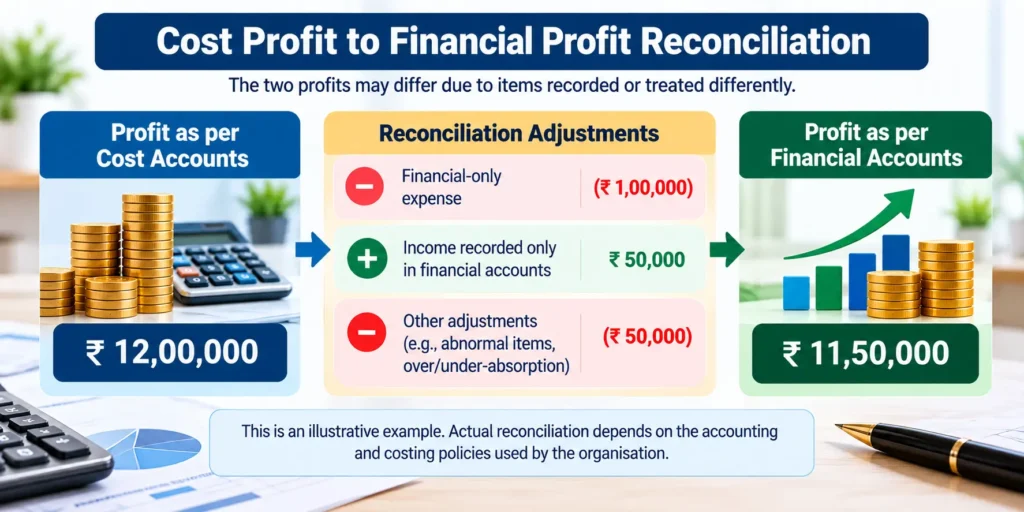
Profit reported by the cost accounts may differ from profit reported by the financial accounts. This can arise because the two systems may use different treatments or bases for inventory valuation, overhead absorption, abnormal items and transactions included in financial accounts but excluded from the relevant costing framework. Differences can arise from inventory valuation, abnormal items, purely financial items and over- or under-absorption of overheads.
8. Is cost accounting mandatory in India?
Not for every business. Specific companies and sectors can be subject to cost-record and cost-audit requirements under Section 148 of the Companies Act, 2013 and the applicable Companies (Cost Records and Audit) Rules. Applicability must be checked against the current Rules and the company’s activities and circumstances.
9. Who uses cost accounting?
Cost accounting is primarily used by management, cost controllers, finance teams, production managers and other internal decision-makers.
10. Who uses financial accounting?
Financial accounting information can be used by management, investors, shareholders, lenders, regulators, tax authorities and other stakeholders.
11. How does cost accounting help with pricing?
Cost accounting provides information about the cost of producing a product or delivering a service. Management can use that information alongside market, competitive and strategic factors when evaluating pricing decisions.
12. What is the relationship between cost accounting and financial accounting?
They are complementary systems. Financial accounting records the broader financial transactions and results of the entity, while cost accounting analyses cost information at a more detailed operational level.
13. Are cost accounting and management accounting the same?
No. Cost accounting focuses mainly on cost determination and analysis. Management accounting is broader and uses cost, financial and non-financial information to support management planning, performance evaluation and decision-making.
14. What changed in cost accounting in India in 2026?
ICMAI’s CAS-25, Cost Accounting Standard on Valuation of Inventory, was approved in February 2026 and is effective from 12 February 2026 for preparation and certification of Cost Accounting Statements. Source: ICMAI Cost Accounting Standards Board (current CAS-25 listing and 2026 announcement).